The Most Profitable Lie In Pricing

Summary
Some of the most profitable pricing tiers change absolutely nothing about the product itself. No extra features, no extra service, sometimes not even a functional difference at all. And customers pay a real premium for them anyway. This piece breaks down prestige pricing, the psychology behind it, and how any business, from a coffee shop to a branding agency, can build a tier that sells recognition instead of more work.
Truecaller Gold does not detect more spam than the plan beneath it. It does not identify callers with any more accuracy, does not add a security feature the free tier lacks, does not do anything you could point to on a spec sheet and call an upgrade. People pay for it anyway, in numbers large enough to matter, and the reason has nothing to do with what the app does. It has to do with what the badge says about the person holding the phone.
That single fact quietly breaks a rule most business owners have never questioned, which is the assumption that a higher price must always be justified by more work. More features, more staff hours, more inventory, more complexity somewhere behind the scenes. It sounds like common sense. If a customer is paying more, they should be getting more. Truecaller is the clearest illustration of the idea, but it is far from the only one, and once you start looking for this pattern you find it running quietly under some of the most profitable companies in the world.
Where the margin actually disappears
Watch what happens when most businesses try to build a premium option. A restaurant adds a premium menu and immediately sources costlier ingredients to justify it. A consultant raises fees and doubles the number of check-in calls. An agency launches a "premium package" and throws two extra account managers at it. A retail brand builds a luxury line by inflating production costs to match the price tag. In every case, revenue climbs while margin barely moves, because every extra dollar earned is chained to extra effort spent delivering it.
The businesses that actually get rich off premium tiers have learned something the rest miss: not every upgrade needs to be built from additional labour. Some of the most profitable upgrades are built from additional perception. A gold interface, a different colour scheme, a badge next to a name, none of that costs much to design once, and once it exists, every customer who chooses that tier costs almost nothing extra to serve. That is about as close to pure margin as a business gets.
None of this is a licence to sell people nothing and call it something. The value in a status tier is still real value, it is simply a different kind. It is recognition, exclusivity, priority, the quiet pleasure of being seen choosing the expensive option. People do not only buy solutions to problems. They buy how owning something makes them feel, and businesses that refuse to take that seriously are leaving money on a table they don't even know exists.
Three kinds of customer, and the one everyone ignores
Every customer base splits, loosely, into three groups. At the base sit the utility seekers, people who want the job done for the least money possible and could not care less about presentation. Above them are the value seekers, who will happily pay more if it buys back their time or removes friction from the process. And then, smaller but often the most profitable of the three, are the status seekers: people whose practical needs are already met, who are now shopping for identity rather than function, who want the experience of being recognised as someone who chose the premium option.
Most businesses build their entire pricing ladder around the first two groups and leave the third completely unserved, which is strange when you consider that luxury brands have built entire empires on serving nobody else. A Rolex tells time no more accurately than a fifty dollar quartz watch, and the gap between them is not a gap in utility, it is a gap in what the object communicates about the person wearing it. A business-class seat lands at the same airport as economy. A VIP wristband at a concert plays the same set list as the general admission ticket behind it. In every one of these cases, the customer is not buying a different outcome, they are buying a different feeling about arriving at the same one.
Economists have a name for goods that get more desirable as they get more expensive, the opposite of how demand is supposed to behave. Veblen goods, named after the economist who first described the pattern over a century ago. The label matters less than the underlying mechanism, which is that price itself can function as a feature. A high number on the receipt is not always a barrier to a sale. Sometimes it is the reason for the sale.
The pattern shows up everywhere once you look
Airlines have run this exact model for decades. A first class seat gets a passenger to the destination marginally sooner, but the wider gap in price buys a boarding priority, a curtain, a flight attendant who knows your name, a lounge with better lighting before takeoff. Delta, Emirates, and every serious carrier in between understand that a large share of what they are selling at the front of the plane is not speed, it is the experience of being treated as someone who matters.
American Express built one of the most profitable consumer finance products in history on the same logic. The Platinum card charges an annual fee that dwarfs its practical utility, and cardholders know this. What they are buying is a metal card that feels different in the hand, a concierge line, and the small social transaction of handing it over at a restaurant table. The credit line underneath it is often no better than a card costing a tenth of the fee.
Streaming and subscription businesses have started building the same instinct into digital products. A Peloton all-access membership does not make the bike pedal any smoother than the app-only tier, but the leaderboard, the on-screen recognition during a live class, and the sense of belonging to a community of people who "take it seriously" are the actual product being sold once the bike itself has already been paid for. Patreon creators routinely offer top-tier supporters nothing more than a name on a credits page or a badge next to their comments, and those tiers are frequently the most profitable line on the creator's income statement, because the cost of granting the recognition is close to zero.
Even something as unglamorous as a bank account follows the pattern. A private banking client and a standard retail client often hold products that are functionally identical, a checking account is a checking account, but the private client gets a dedicated relationship manager, an invitation to events, and a black card that signals something different at checkout. The infrastructure behind both accounts is frequently the same system.
What this looks like inside an actual business
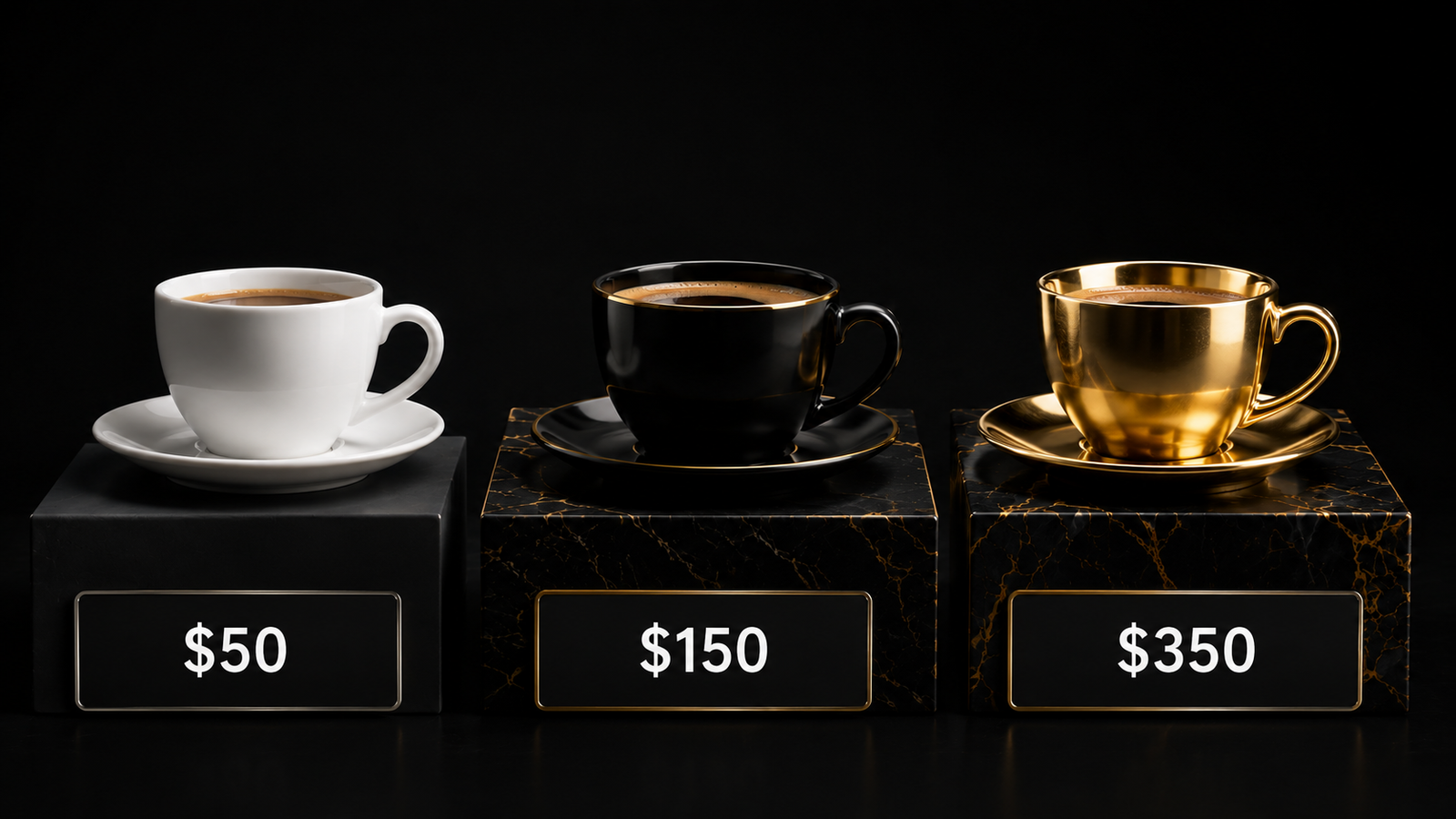
Take something as ordinary as a coffee shop. The regular customer gets an excellent cup, full stop. A "member" customer gets the same excellent coffee, but pulled from a reserve blend, served in a ceramic mug reserved for the members list, that mug sitting on a shelf where every other customer can see it. The coffee itself barely costs more to produce. The experience of owning that mug costs the shop almost nothing and means everything to the person it belongs to.
A branding agency, the kind of client BrandForge works with every week, can do the same thing without redesigning a single strategy deck. The actual thinking behind a premium client's campaign might be identical to what a standard client receives, but the premium client gets it bound properly, gets faster response times, gets a seat at a quarterly review nobody else is invited to, gets direct access to the people at the top of the org chart instead of an account executive three layers down. The intellectual work has not changed. The experience of being that client has changed completely, and that difference is exactly what people are willing to pay for.
An e-commerce brand can apply the identical logic through collector packaging, numbered editions, handwritten notes tucked into the box, or early access windows before a product goes public. None of it touches the product itself. All of it changes how the buyer feels about owning it, and feeling is the thing that gets shared, photographed, and talked about.
How to build a status tier without cheapening the brand
The temptation, once this pattern is visible, is to slap a "premium" label on something and raise the price. That is a fast way to damage trust rather than build margin. A status tier only works if three conditions hold.
The recognition has to be visible to someone other than the buyer. Status that nobody else can perceive is just a discount in reverse. A badge, a name plate, a different colour of card, a seat that other people can see, something has to make the choice legible to an audience beyond the person who made it.
The tier has to be scarce enough to mean something, whether that scarcity is real or simply well managed. If every customer ends up in the gold tier within a year, gold stops communicating anything, and the businesses that get this right protect the boundary of the tier as carefully as they protect the product itself.
And the practical product underneath still has to be genuinely good. Status sells fastest on top of something customers already trust. Selling recognition on top of a mediocre core product reads as a gimmick, and customers notice the difference between paying for prestige and paying to disguise a shortfall.
Why people keep paying for a feeling
Every purchase is, in some quiet way, a statement about identity. Sometimes that statement is aimed outward, toward the people who will notice the card, the seat, or the badge. Sometimes it is aimed nowhere but inward, at the private satisfaction of having rewarded yourself for the year you have just had. Either way, it explains why premium tiers keep selling even when the broader economy gives people every reason to cut back. People are rarely shopping only for what they need. They are shopping for the story that comes with owning it, and a business that understands this is no longer only selling a product. It is selling an emotion with a price tag attached.
Somewhere inside your existing customer list are people who would pay more than your most expensive package today if you simply gave them a reason worth paying for. Not a reason built from more features. A reason built from more recognition. Utility keeps a business running. Status is what turns an ordinary business into one with margins nobody else in the market can explain.
This is the layer of pricing strategy BrandForge builds into growth plans for founders and companies ready to stop competing only on price. If your business has outgrown "cheaper" as a strategy, that conversation starts at brandforgeinc.com.
About the Author